Product Categories:


Wait, don't go!
Before you leave, we have a special offer just for you!
Get 20% off your next purchase.

Product Categories:
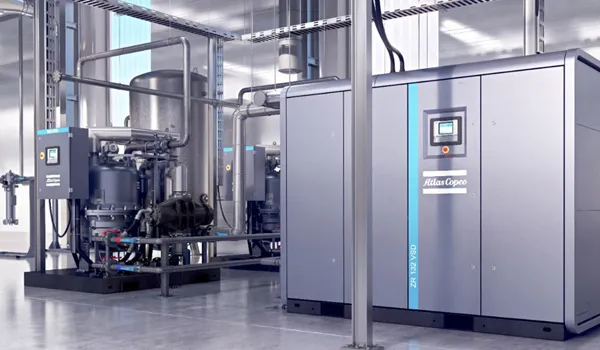
Explore Atlas Copco Air Compressor System
A nitrogen generator is industrial equipment that separates nitrogen molecules from compressed atmospheric air. It filters out oxygen, carbon dioxide, water vapour and trace contaminants to deliver a steady stream of purified nitrogen gas ready for manufacturing use.
Earth’s ambient air contains roughly 78 % nitrogen. While nitrogen is abundant in nature, most industrial processes demand nitrogen with controlled purity, pressure and flow rate that raw atmospheric air cannot satisfy. Nitrogen generators enable factories to produce high‑quality nitrogen directly on‑site instead of purchasing bottled or bulk liquid nitrogen delivered by external suppliers. This article breaks down the operating principles, two mainstream generation technologies, system composition, real‑world applications and core advantages of on‑site nitrogen production.
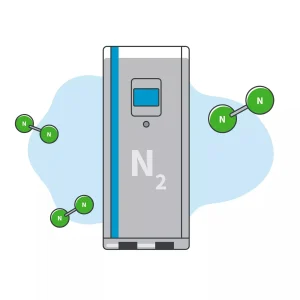
A nitrogen generator is industrial equipment that separates nitrogen molecules from compressed atmospheric air. It filters out oxygen, carbon dioxide, water vapour and trace contaminants to deliver a steady stream of purified nitrogen gas ready for manufacturing use.
Its primary mission is to deliver continuous, on‑demand inert nitrogen matched to application‑specific purity requirements. Industries that rely on controlled oxidation‑free environments widely adopt this solution, including electronics manufacturing, food & beverage processing, chemical production, automotive and metal fabrication. By generating nitrogen in‑house, facilities gain operational independence, cut logistical burdens and reduce safety hazards associated with handling high‑pressure gas cylinders.
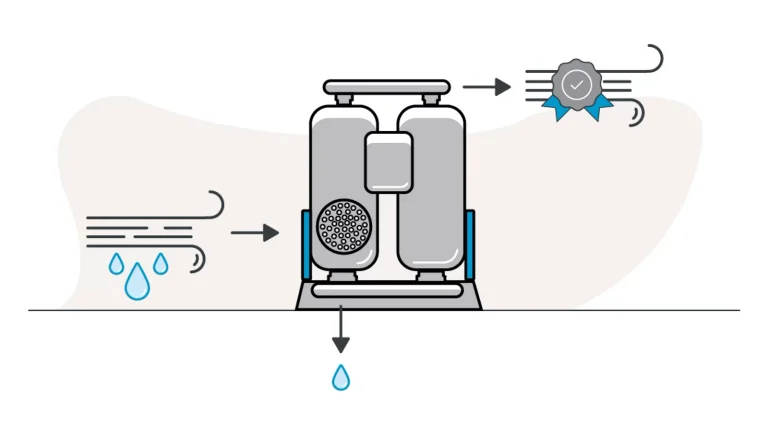
All nitrogen generators start with clean, dry compressed air as raw feed gas. Inside the unit, specialised separation media segregate nitrogen from unwanted gas components. Purified nitrogen can feed processes immediately or flow into buffer storage tanks to cover peak consumption periods.
Two proven technologies dominate modern nitrogen‑generation hardware: membrane separation and Pressure Swing Adsorption (PSA). Process engineers select technology according to target nitrogen purity, required gas flow and site operating conditions. Membrane systems fit applications requiring purity up to 99 %. PSA technology delivers ultra‑high‑purity nitrogen reaching 99.999 % for strict‑spec production such as food packaging and polymer processing.
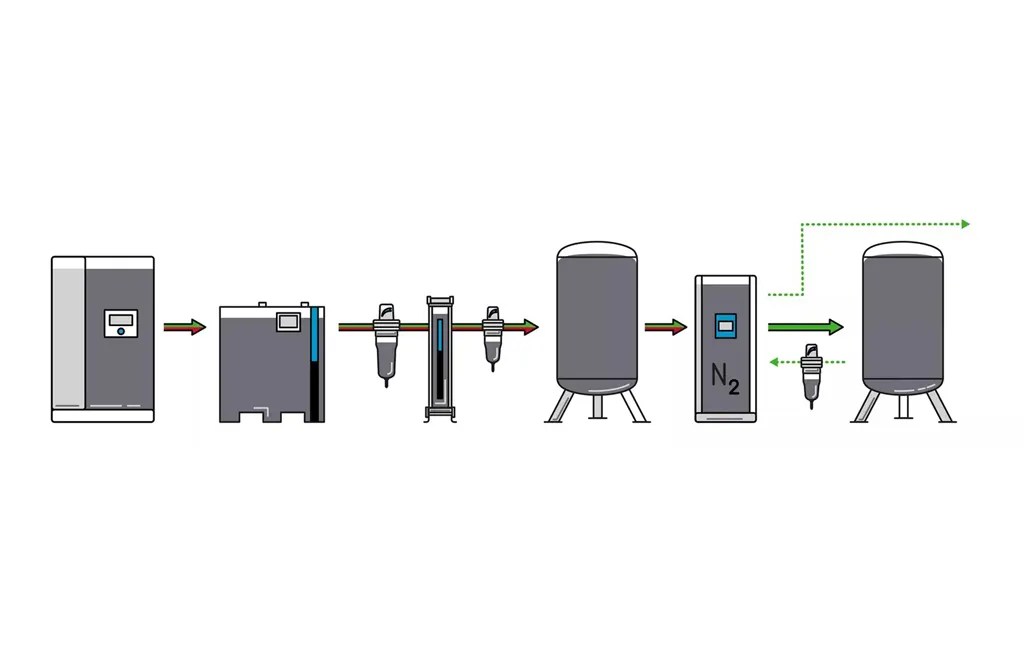
A standalone on‑site nitrogen plant consists of multiple complementary components beyond the generator unit itself:
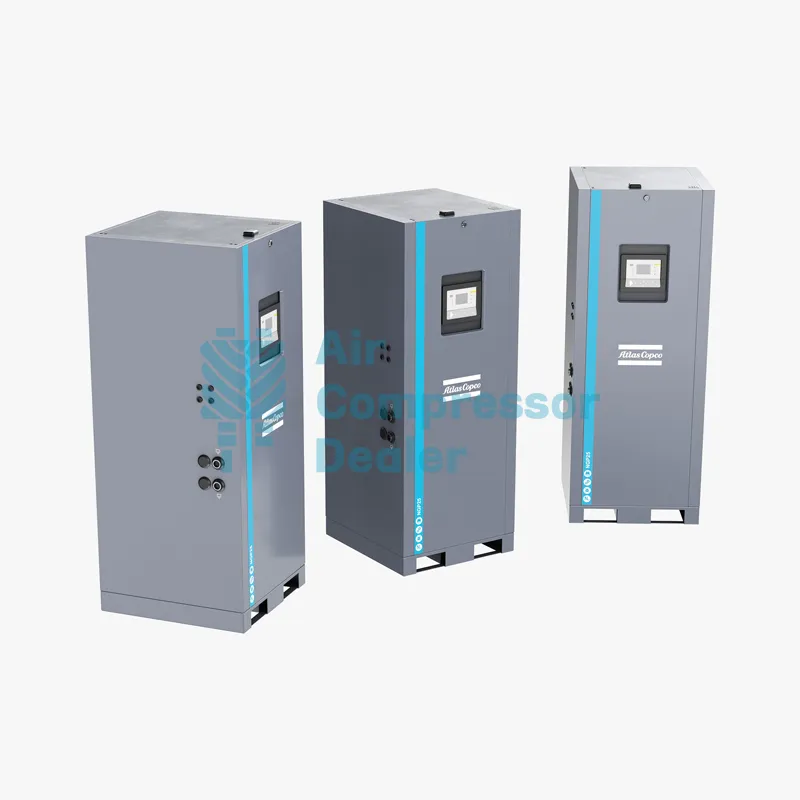
Membrane generators operate using bundles of tiny hollow semi‑permeable fibres. Pre‑treated compressed air flows through the interior of these hollow‑fiber modules. Gas molecules behave differently when contacting the membrane surface: oxygen, water vapour and other trace gases readily permeate through the fibre walls and vent to atmosphere. Nitrogen cannot pass through the membrane material and continues along the fibre bore toward the equipment outlet port.
Since water vapour also permeates out through the membrane, output nitrogen achieves extremely low dew‑points down to ‑50 °C (‑58 °F). Membrane‑type generators feature simple mechanical construction with few wearing components, minimal maintenance needs and compact footprint. They are most cost‑effective for moderate‑flow projects with nitrogen purity below 99 %, such as tyre inflation and fire‑suppression blanketing. Initial capital expenditure is lower compared to PSA systems, yet they cannot economically reach ultra‑high‑purity grades.
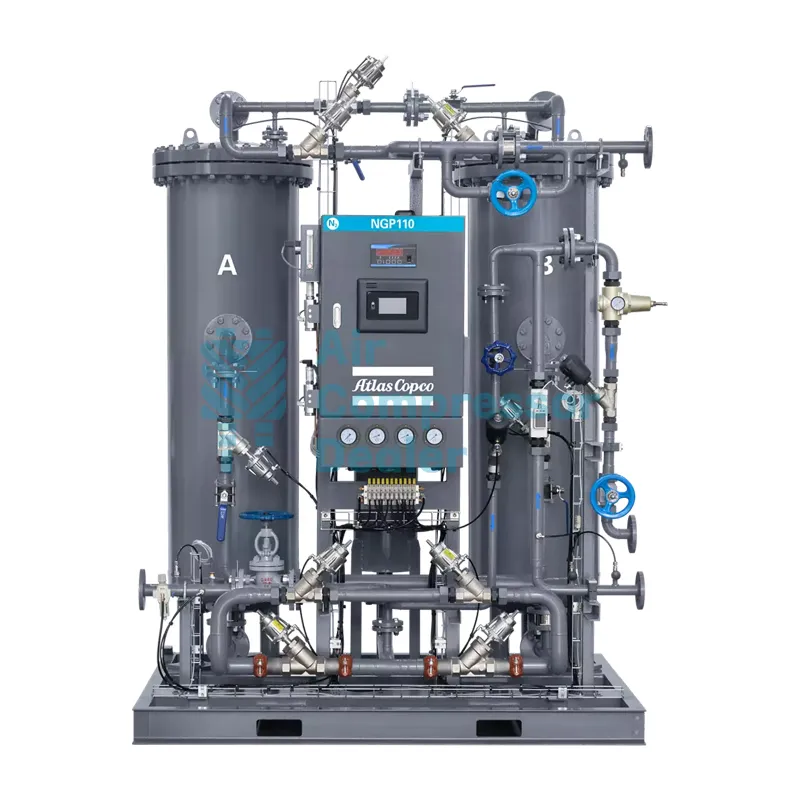
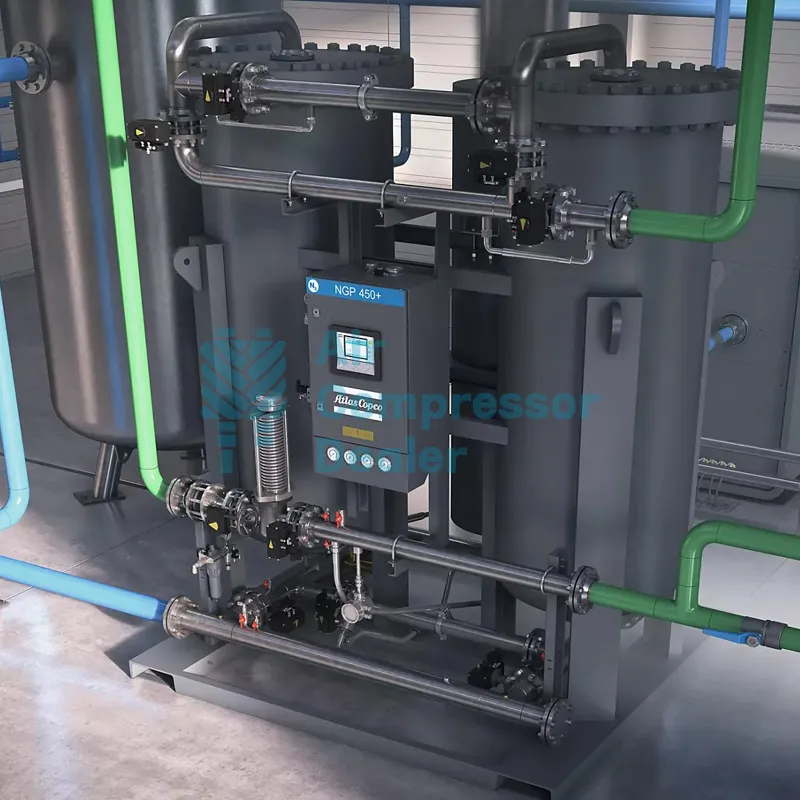
PSA technology relies on adsorption: gas molecules adhere physically to the surface of solid adsorbent material. PSA units are fitted with two parallel pressure vessels filled with carbon molecular sieve (CMS). Carbon molecular sieve traps smaller‑sized oxygen molecules under elevated pressure while letting larger nitrogen molecules pass through unobstructed.
The two towers automatically switch cycles between adsorption (gas production phase) and desorption / regeneration (sieve cleaning phase):
PSA systems reliably achieve nitrogen purity up to 99.999 % for high‑demanding industrial workflows. They demand higher upfront investment than membrane generators, yet they excel for high‑flow and ultra‑high‑purity use‑cases across food processing, heat treatment, electronics and chemical manufacturing.
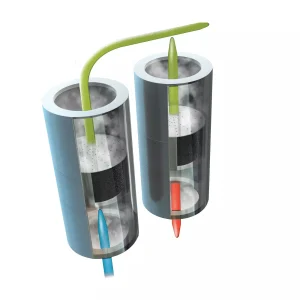
| PSA | MEMBRANE | |
| ACHIEVABLE PURITY | EFFICIENTLY UP TO 99.999% | EFFICIENTLY UP TO 99.9% |
| EFFICIENCY | HIGHER | HIGH |
| PERFORMANCE VS. TEMP. | LOWER AT HIGH TEMP. | HIGHER AT HIGH TEMP. |
| SYSTEM COMPLEXITY | MEDIUM | LOW |
| SERVICE INTENSITY | LOW | VERY LOW |
| PRESSURE STABILITY | FLUCTUATING IN/OUTLET | STABLE |
| FLOW STABILITY | FLUCTUATING IN/OUTLET | STABLE |
| START-UP SPEED | MINUTES/HOURS | SECONDS |
| WATER (VAPOUR) SENSITIVITY | PDP MAX 8°C | NO LIQUID WATER |
| OIL SENSITIVITY | NOT ALLOWED (< 0,01mg/m³) | NOT ALLOWED (< 0,01mg/m³) |
| NOISE LEVEL | HIGH (blow-off peaks) | VERY LOW |
| WEIGHT | MEDIUM | LOW |
Membrane hardware contains almost no moving parts, making it ideal for installations aiming to minimise downtime risk. PSA units require careful inlet‑air conditioning and routine filter maintenance; when properly serviced, PSA delivers superior purity and consistent performance for critical production lines.
Nitrogen is chemically inert, odour‑free and suppresses oxidation reactions, which underpins its wide industrial adoption:
Generating nitrogen on‑site grants factories full control over gas purity, flow and outlet pressure, bringing tangible operational and financial benefits compared with purchasing externally supplied nitrogen:
Technology selection should evaluate required nitrogen purity, volumetric flow rate, ambient site environment and total‑cost‑of‑ownership targets. Compact membrane nitrogen generators suit simple, moderate‑purity requirements. Where ultra‑high‑purity nitrogen is mandatory, PSA systems represent the optimal technical solution. Working with compressed‑air and gas‑generation specialists helps match system configuration precisely to process requirements and maximise long‑term efficiency gains.
1.How a nitrogen generator works https://www.atlascopco.com/en-tw/compressors/air-compressor-blog/how-a-nitrogen-generator-works